What I wish someone had told me before my kidneys paid the price.

When I was first told to restrict my fluids, I smiled, nodded at the doctor, and went home and drank a full glass of water because I was thirsty.
I mean — it’s just water. How bad could it be?
That was one of the lies I told myself. And it cost me.
If you’ve ever lived with kidney disease — whether on dialysis or managing CKD — you’ve probably told yourself at least one of these lies too.
Today we’re calling them out, not to shame anyone, but because the truth is what actually keeps us alive and living well.

Lie #1: “A little extra won’t hurt.”
This is the most common one, and honestly, the most dangerous. We think in terms of feeling — if I don’t feel swollen, if my ankles look fine today, surely one extra cup of tea is harmless.
But fluid doesn’t always show up immediately. It hides. It settles around your lungs and heart before it ever shows on your ankles. By the time you feel it, the damage is already happening.
The truth: your fluid limit is not a suggestion. It’s a boundary your body can no longer negotiate past.
Lie #2: “I’m thirsty, so my body must need it.”
Oh, this one broke my heart when I understood it properly. Thirst is controlled by your brain — and in kidney disease, especially on dialysis, your brain can send thirst signals that your body cannot actually process safely.
Your body feels like it needs more. But what it actually needs is for the fluid you already have to be managed properly.
Thirst in kidney disease is not always a green light. It’s often a signal to slow down and assess.
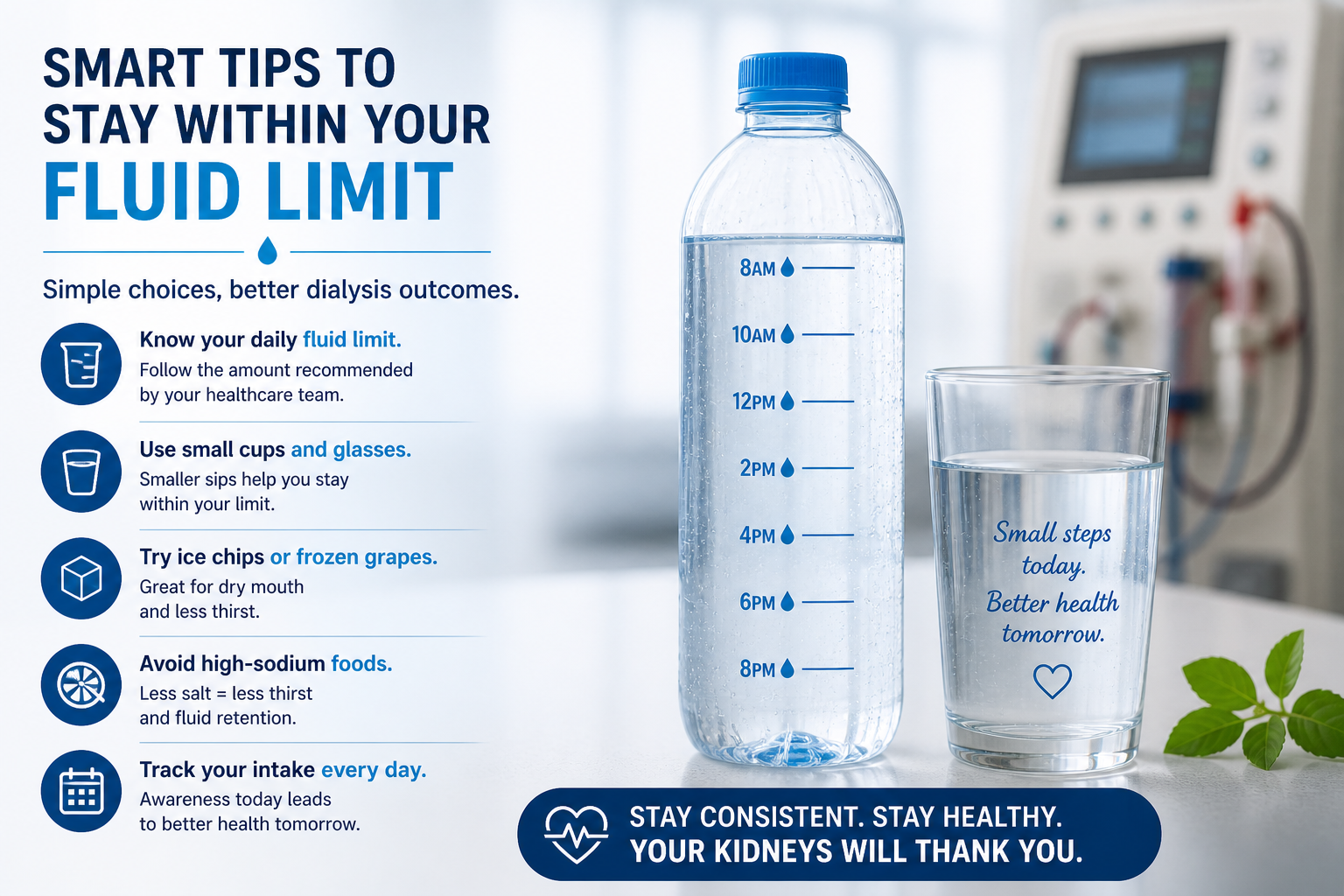
What helps: ice chips instead of full sips, lemon slices to ease dry mouth, small frequent sips rather than full glasses.
Lie #3: “This rule is for serious patients, not me.”
I’ve heard this one so many times — and I’ve said it myself during periods when I felt “okay.” When your numbers aren’t too bad, when you’re not yet on dialysis, it’s easy to think fluid restriction doesn’t apply to you yet.
But here’s what I’ve learned through 15 years of living this: the patients who start taking these limits seriously before things get bad are the ones who stay out of the emergency room longer.
Fluid restriction is not punishment for being sick. It’s protection for staying as well as possible.
Lie #4: “I can make up for it later.”
There’s no such thing as “fluid fasting” to make up for yesterday’s overdrink. Your kidneys — or your dialysis machine — can only process so much.
The excess stays in your body causing harm while you’re waiting to “catch up.”
Every day is its own fluid budget. Spend it wisely.

What I’ve Learned After 15 Years
Fluid restriction is not about deprivation. It is about learning to live wisely within a new reality — and once you stop fighting it, something unexpected happens: you find peace in the discipline.
You learn to sip slowly. To savour. To plan. And weirdly, you start to appreciate water in a way most people never will.
That’s the gift hidden inside the restriction.
This month on Kidney Health Awareness Ghana, we’re diving deep into the topic of Restrictions & Diet — Living Wisely, Not Fearfully. Each week we’ll cover a different area. This week, we’re talking fluids.
If this post helped you or someone you love, please restack it or share it. And tell me — which of these lies have you told yourself? I’d love to hear in the comments. 💙