Category: Dialysis

  • High Cholesterol and Your Kidneys: What Nobody Is Telling You

    High Cholesterol and Your Kidneys: What Nobody Is Telling You

    You have probably heard that high cholesterol is bad for your heart. But here is something most people — including many patients — are never told: high cholesterol is also quietly destroying your kidneys.

    This is not a scare tactic. This is something I had to learn the hard way, living with kidney disease and dialysis for over 15 years. And today, I want to make sure you do not find out too late.

    Whether you are perfectly healthy and want to stay that way, or you are already managing kidney disease — this article is for you.

    What Is Cholesterol, Really?

    Cholesterol is a fatty substance found naturally in your blood. Your body actually needs some cholesterol to function — it helps build cells and produce certain hormones. The problem begins when there is too much of it.

    There are two main types you need to know:

    LDL (Low-Density Lipoprotein) — This is the “bad” cholesterol. Too much LDL causes a build-up of fatty plaques in your blood vessels, narrowing them and reducing blood flow.

    HDL (High-Density Lipoprotein) — This is the “good” cholesterol. HDL helps carry excess cholesterol away from your arteries and back to your liver to be removed.
    When your LDL is too high and your HDL is too low — that is when the trouble starts.

    The Kidney-Cholesterol Connection Nobody Talks About

    Your kidneys are fed by a network of tiny, delicate blood vessels. Every minute, they filter about half a cup of blood — cleaning out waste, balancing fluids, and regulating what stays in your body and what leaves.

    When cholesterol is too high, those blood vessels begin to narrow. Fatty deposits — called plaques — build up along the vessel walls. Less blood reaches the kidneys. And when the kidneys are not getting enough blood, they cannot do their job properly.

    Over time, this leads to:

    • Reduced kidney function

    • High blood pressure (which then damages the kidneys even further — a vicious cycle)

    • Increased risk of chronic kidney disease (CKD)

    • For those already living with CKD, a much faster rate of decline

    Here is the part that shocks most people: this damage happens silently. You will not feel your blood vessels narrowing. You will not feel your kidneys struggling. By the time symptoms show up, significant damage may have already been done.

    What About Dialysis Patients?

    If you are on dialysis, please pay close attention to this section.
    Many dialysis patients assume that because the machine is cleaning their blood, they do not need to worry as much about what they eat. I understand that thinking — I had it too.

    But here is the truth: dialysis does not remove cholesterol from your blood.

    Dialysis removes waste products like urea and creatinine. It removes excess fluids. But it does not filter out fat. That responsibility still belongs entirely to you — to what you eat, how you move, and how you manage your health between sessions.

    Dialysis patients already face a significantly higher cardiovascular risk than the general population. High cholesterol on top of that is like adding fuel to a fire. The damage to blood vessels accelerates. The risk of heart attack and stroke increases. And your overall quality of life — and survival — is affected.

    This is not meant to frighten you. It is meant to empower you to make choices that protect you.

    Foods That Spike Your Cholesterol (Including Ghanaian Favourites)

    Let us be honest — some of these will be familiar. That is okay. Awareness is the first step.
    Foods that raise LDL (bad) cholesterol:

    • Deep-fried foods — Kelewele, bofrot, fried yam, fried plantain eaten daily

    • Excess palm oil — A staple in Ghanaian cooking, but in large quantities it raises saturated fat significantly

    • Coconut oil in large amounts — Despite its popularity, it is high in saturated fat

    • Full-fat evaporated milk — Commonly added to tea, porridge, and oats

    • Processed meats — Sausages, corned beef, canned sardines in heavy oil

    • Waakye with the full works — Spaghetti, stew, sausage, and fried fish all together is a cholesterol feast

    • Meat pie, sausage roll, and biscuits — High in trans fats from the pastry

    • Indomie with the full seasoning sachet — The seasoning is loaded with sodium and additives that affect cholesterol metabolism

    • Red meat eaten too frequently — Beef, goat, pork; enjoy occasionally, not daily

    • Butter and margarine — Especially in large amounts

    • Egg yolks in excess — More than 3 a week is generally not recommended for CKD patients

    What to Eat Instead

    The good news is that there are delicious, accessible foods that actually help protect your kidneys and manage cholesterol — many of which you already know.
    Foods that lower LDL and support kidney health:

    • Garden eggs (African eggplant) — One of the most underrated foods in Ghana. They contain compounds that actively help reduce cholesterol. Eat them often.

    • Oats — A simple oats porridge in the morning is one of the best things you can do for your cholesterol.

    • Fresh fish — boiled or grilled — Tilapia, herring, and mackerel are excellent. The key is how you prepare them. Boil or grill instead of frying.

    • Beans and lentels — Excellent for cholesterol management and gentle on the kidneys when eaten in appropriate portions.

    • Kontomire (cocoyam leaves) — Rich in nutrients and a great base for stews without the heavy oil.

    • Fresh fruits — Apples, pears, and berries are particularly good for cholesterol.

    • Water — Staying hydrated helps your kidneys flush out waste more effectively.

    One simple rule to remember: boiled or grilled over fried — always.

    Could Your Cholesterol Be Genetic?

    This is something many people do not know: cholesterol can be genetic.

    There is a condition called Familial Hypercholesterolaemia (FH) — where a person is born with a gene that causes their liver to produce too much cholesterol, regardless of what they eat. So even if you eat clean and exercise regularly, your cholesterol levels may still be dangerously high.

    Signs that your high cholesterol might be genetic:

    • Your cholesterol has been high since you were young

    • You have a family history of high cholesterol or early heart attacks

    • Your cholesterol remains high even after significant dietary changes

    If this sounds like you — please tell your doctor. You may need medication such as statins, alongside dietary changes, to manage your levels effectively. Diet alone may not be enough.

    What Tests Should You Ask For?

    Most people managing cholesterol only check their LDL and HDL levels. But there are two additional markers that give a much fuller picture — especially for kidney patients:

    Homocysteine — An amino acid that, when elevated, increases the risk of arterial damage and cardiovascular disease. Declining kidney function directly raises homocysteine levels. Ask your doctor to check it.

    ApoB (Apolipoprotein B) — A more precise measure of the cholesterol particles that cause arterial damage. Many cardiologists now consider it more accurate than LDL alone.

    If you have kidney disease and nobody has checked your homocysteine or ApoB alongside your kidney function — bring it up at your next appointment. You deserve the full picture of your health.

    Here is what I want you to walk away with today:

    1. Get a lipid panel blood test — Know your LDL, HDL, and total cholesterol numbers. Also ask for homocysteine and ApoB if you have kidney disease.

    2. Tell your doctor your family history — High cholesterol in parents or grandparents matters. Mention it.

    3. Reduce fried foods — You do not have to eliminate them completely. But daily frying is damaging your vessels daily.

    4. Swap in kidney-friendly foods — Garden eggs, oats, fresh fish, beans. Start with one swap this week.

    5. If you are on dialysis — talk to your dietitian — Ask specifically about cholesterol management for dialysis patients. It is a conversation worth having.

    Final Words — From Someone Who Knows

    I have been living with kidney disease for over 15 years. I have been on dialysis. I have had a transplant. And through all of it, I have learned that the choices we make every day — especially at the table — matter enormously.

    Nobody told me early enough that my cholesterol and my kidneys were in a relationship. I had to discover it through experience and research.

    You do not have to wait that long.

    Your kidneys are working hard for you every single day. Feed them right. Protect your vessels.

    Ask the questions your doctor may not think to bring up.

    Knowledge protects. And I hope this article has given you some today. 💙

    Hilda is the Founder of The Kidney Advocate and Kidney Health Awareness Ghana (KHAG). She has lived with kidney disease for over 15 years and is passionate about making kidney health education accessible to Ghanaian communities. Visit her at thekidneyadvocate.blog.

    Did you find this article helpful? Share it with someone who needs it. And leave a comment below — have you ever had your cholesterol checked alongside your kidney function? I would love to hear from you. 🫘
  • Your Medication Tray Is Doing What Your Kidneys Can’t: A Complete Guide to Dialysis Medications

    Your Medication Tray Is Doing What Your Kidneys Can’t: A Complete Guide to Dialysis Medications

    When I first started dialysis, nobody sat me down and explained my medications. A nurse handed me a tray. A doctor rattled off names. And I sat there, nodding, pretending I understood — while quietly wondering why I needed so many tablets just to stay alive.

    Fifteen years later — through dialysis, a transplant, and back to dialysis again — I can tell you this: understanding your medications is not optional. It is one of the most powerful things you can do for your own survival.

    This article is what I wish someone had handed me on day one.

    Why Dialysis Patients Need So Many Medications

    Here is the thing people don’t realise: dialysis cleans your blood. That’s it. It filters waste and removes excess fluid. But your kidneys did so much more than that — they regulated hormones, activated vitamins, controlled blood pressure, managed minerals. Dialysis doesn’t replace any of that.

    Your medications do.

    Every tablet on your tray is filling a gap that your kidneys left behind. Once I understood that, the tray stopped feeling like a punishment and started feeling like a support system.

    The Medications, Explained Simply

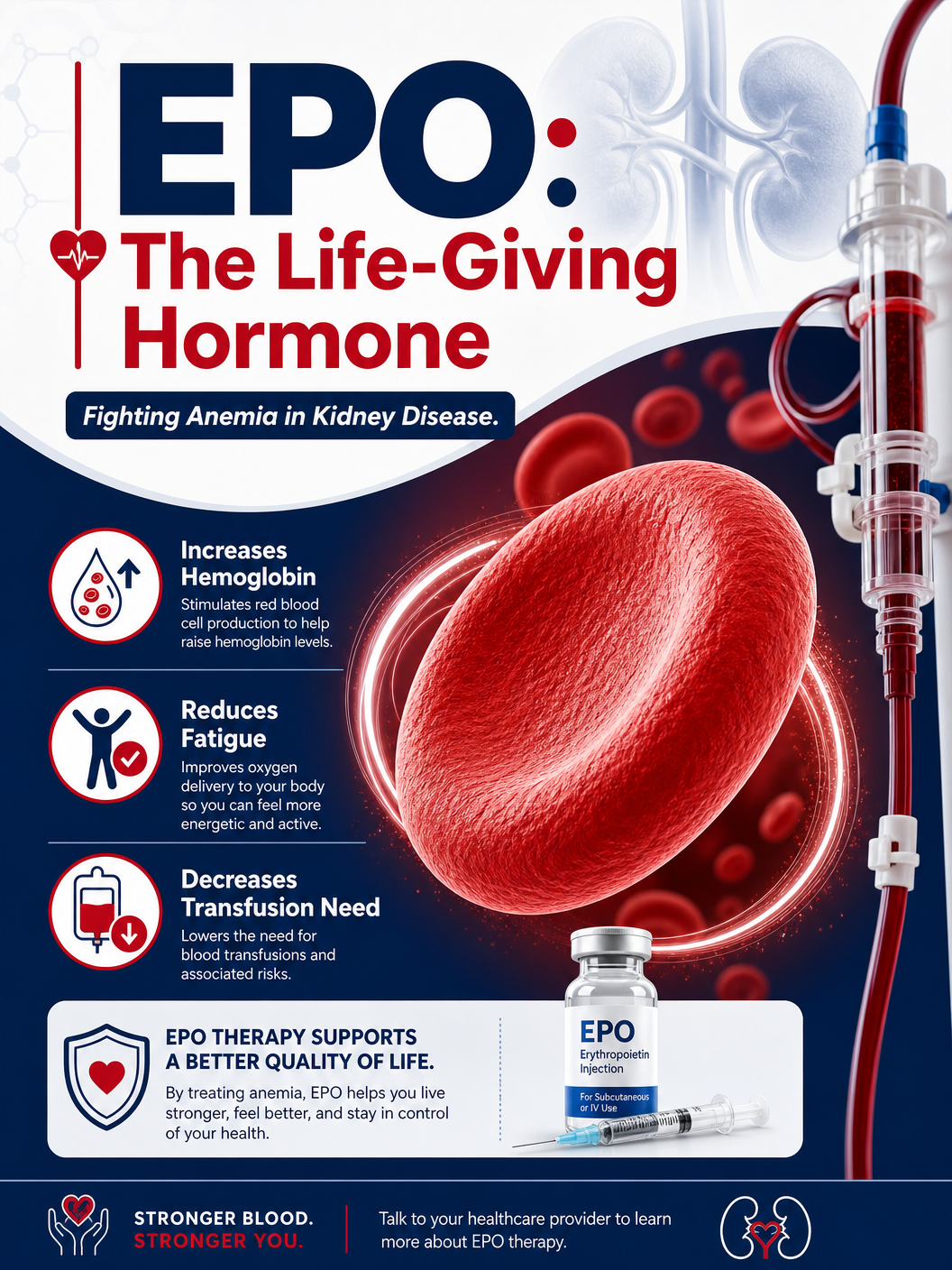
    EPO — Erythropoietin

    Your kidneys produce a hormone called erythropoietin, which tells your bone marrow to manufacture red blood cells. When your kidneys fail, EPO production drops dramatically. The result is anaemia — not the mild tiredness kind, but the kind that leaves you unable to walk across a room without gasping, pale, foggy, and barely functional.

    EPO is that hormone, synthesised and given as an injection — either subcutaneously (under the skin) or through your dialysis line during your session.

    I remember the difference EPO made when my haemoglobin was finally managed properly. I didn’t realise how exhausted I had been until I wasn’t anymore.

    EPO is not without risks — it can raise blood pressure and, in rare cases, cause a condition called pure red cell aplasia. But for most dialysis patients, it is life-changing and non-negotiable.

    Iron — Encifer and Other Formulations

    EPO cannot work without adequate iron. Think of EPO as the instruction and iron as the raw material. Your body cannot build red blood cells without enough iron in storage — no matter how much EPO it receives.

    Dialysis patients lose iron continuously — through the dialysis process itself, through regular blood draws, and through the chronic low-grade inflammation that kidney disease causes. Encifer is one brand of intravenous iron used in dialysis centres. Some patients also take oral iron supplements, though absorption is often poor in kidney disease.

    Your iron status is tracked through two key markers: ferritin (your iron stores) and transferrin saturation (TSAT — how much of your iron-carrying protein is actually loaded with iron). Learn these numbers. Ask for them at your next review.

    Blood Pressure Medications — Antihypertensives

    Kidney disease and high blood pressure have a deeply destructive relationship. Damaged kidneys cannot regulate sodium and fluid properly, which drives blood pressure up. Sustained high blood pressure then accelerates kidney damage further. Even on dialysis, this cycle continues.

    You may be on one antihypertensive or several. ACE inhibitors, ARBs, calcium channel blockers, beta-blockers, alpha-blockers — each works on a different mechanism, and your nephrologist has chosen yours based on your specific cardiovascular and kidney profile.

    The most important thing: take them consistently. Including on dialysis days, unless your doctor has explicitly told you otherwise. A common and dangerous mistake is skipping them on dialysis days, assuming the machine will handle it. It won’t — not fully, and not safely.

    Post-dialysis hypotension is also real. Your blood pressure can drop significantly after a session. Talk to your team about whether your doses should be timed before or after dialysis to reduce this risk.

    Calcichew — Calcium Carbonate (Phosphate Binder)

    This one comes with a very specific instruction: take it with food. Not before. Not after. With your meal, as you eat.

    Here is why. When you eat, phosphorus from your food enters your digestive system. Calcichew — a form of calcium carbonate — binds to that phosphorus in your gut before your body can absorb it. The phosphorus then leaves your body through your stool rather than entering your bloodstream.

    High phosphorus (hyperphosphataemia) is one of the most dangerous and under-discussed complications of kidney disease. It causes severe itching, bone disease, and vascular calcification — where calcium-phosphorus crystals deposit in your blood vessels and heart valves. This leads to serious cardiovascular complications and is a significant cause of death in dialysis patients.

    Other binders exist — sevelamer (Renagel/Renvela), lanthanum carbonate (Fosrenol), sucroferric oxyhydroxide (Velphoro) — and your prescription depends on your calcium levels and your centre’s protocols. The principle is the same for all of them: they must be taken with meals to intercept the phosphorus before absorption.

    Alfacalcidol — Active Vitamin D

    Most people don’t know that your kidneys activate Vitamin D. The Vitamin D from sunlight or supplements exists in an inactive form. Your kidneys convert it into calcitriol — the active form your body can actually use to absorb calcium from your gut.

    When kidneys fail, this activation stops. Without active Vitamin D, calcium absorption drops, and your parathyroid glands — sensing low calcium in the blood — go into overdrive. They produce excess parathyroid hormone (PTH), which pulls calcium out of your bones to compensate. Over time, this causes renal osteodystrophy: weak, painful, fracture-prone bones. Excess PTH also causes calcification in soft tissues, blood vessels, and organs.

    Alfacalcidol is the active form of Vitamin D, replacing what your kidneys can no longer produce. It requires regular calcium monitoring, because too much can push calcium too high (hypercalcaemia). The goal is a careful balance — enough to suppress PTH and protect your bones, without tipping into excess.

    Why Compliance Is Not Negotiable

    Medication fatigue is real. I have felt it. There are days when the tray is the last thing you want to see, when being a patient feels like a full-time job you never applied for.

    But here is what happens, concretely, when these medications are skipped:

    Skip EPO: Haemoglobin falls. Transfusions become necessary. Each transfusion introduces foreign antibodies that make transplant matching harder and rejection more likely. For anyone on the transplant waiting list, this is a serious, potentially irreversible consequence.

    Skip your phosphate binder: Phosphorus climbs — usually without any obvious symptoms at first. Itching begins. Calcification progresses silently. Cardiac events follow. By the time it feels serious, significant damage may already have occurred.

    Skip BP medications: Blood pressure spikes. Fistulas and grafts clot. Stroke risk rises sharply. In a population already at elevated cardiovascular risk, uncontrolled hypertension is an accelerant.

    Skip alfacalcidol: PTH climbs unchecked. Bone pain develops gradually, then suddenly. Fractures become more likely. In some cases, the parathyroid becomes so enlarged it requires surgical removal — a parathyroidectomy.

    Skip iron: EPO becomes ineffective. Haemoglobin stays low despite the injection. Fatigue persists. The full benefit of your EPO is wasted.

    Understanding the why behind each medication transforms compliance from obedience into informed self-preservation. You are not taking these tablets because you were told to. You are taking them because they are doing the work your kidneys stopped doing.

    Managing the Side Effects

    Epo

    Can raise blood pressure — monitor yours closely, especially after starting or after a dose increase. Some patients experience mild flu-like symptoms for a day or two after injection. If your haemoglobin drops suddenly and unexpectedly despite regular EPO, flag this immediately — it can rarely indicate pure red cell aplasia.

    Iron

    Nausea and metallic taste are common, especially with IV iron. Dark or black stools are expected and harmless — that is unabsorbed iron. During IV iron infusions, your unit should monitor you for reactions. Oral iron is best taken with a small amount of food to reduce stomach upset.

    Blood Pressure Medications

    Post-dialysis hypotension is the main concern — your pressure may drop significantly after a session, making dizziness and falls more likely. Sit before you stand. Don’t skip meals. Discuss timing of your dose with your nephrologist, as some medications are better taken after dialysis rather than before.

    Calcichew

    Constipation is the most common complaint. Work within your fluid allowance and ask your renal dietitian about fibre sources that are also low-phosphorus. The chalky taste bothers some people — chewing quickly and following with a small permitted sip of water helps. If you are struggling with adherence because of the taste or texture, ask your pharmacist about alternative binders.

    Alfacalcidol

    Hypercalcaemia — too-high calcium — is the risk to watch for. Symptoms include nausea, confusion, excessive thirst, constipation, and muscle weakness. These overlap with many other conditions, which is why regular calcium blood monitoring is essential. Tell your team immediately if anything feels off.

    You Are Your Own Best Advocate

    Ask what every tablet is for. Ask what happens if you miss a dose. Ask about side effects and what to watch for. Request a medication review if your regimen feels overwhelming or something has changed.

    You deserve to understand every single thing going into your body. Not because you are a doctor. But because you are the person living inside this body, managing this condition, and making decisions every single day.

    Your medication tray is doing the work your kidneys can’t. Understand it. Work with it. And advocate loudly when something doesn’t feel right.

  • Dialysis — What No One Tells You Before You Start

    Dialysis — What No One Tells You Before You Start

    When someone tells you that you need to start dialysis, your brain doesn’t process it like information. It lands like a verdict.

    I know because I’ve been there. I sat in that chair — or maybe I was standing, or pacing, I honestly can’t remember — and all I heard after a point was noise. The doctor kept talking. I kept nodding. And somewhere inside me, something very quiet broke.

    That’s the part nobody puts in the brochure.

    So today, I want to talk about dialysis the way I wish someone had talked to me about it — not with medical jargon, not with a clipboard, but with honesty and a little grace.

    So, what actually is dialysis?

    Your kidneys are supposed to be your body’s filter. Every single day, they clean your blood, remove waste, balance your fluids, and regulate things like blood pressure and mineral levels. When kidneys fail — whether slowly over years or more suddenly — that work stops getting done.

    Dialysis is a machine (or a method) that steps in to do the job your kidneys can no longer do.
    There are two main types:

    Hemodialysis is what most people picture — you’re connected to a machine through access points in your body (usually a fistula or a catheter), and your blood is cleaned outside your body and returned to you. Sessions typically happen three times a week and last around four hours each.

    Peritoneal dialysis uses the lining of your abdomen as the filter. A fluid is introduced through a catheter in your belly, it absorbs waste, and then it’s drained out. This one can often be done at home.

    Both do the same essential job. Which one is right for you depends on your health, your lifestyle, and what your medical team recommends.

    Why does dialysis become necessary?

    Kidney disease is often quiet. For years — sometimes decades — your kidneys can lose function without you feeling dramatically different. That’s both a mercy and a trap, because by the time symptoms appear, the damage is often significant.

    When kidney function drops to a critical level (typically around 10–15% of normal), your body can no longer safely manage on its own. Waste builds up in the blood. Fluid accumulates where it shouldn’t. The heart, lungs, and brain begin to feel the effects.

    At that point, dialysis isn’t a last resort. It becomes a lifeline.
    For some people it’s a bridge — they start dialysis while waiting for a transplant. For others, it becomes a long-term way of life.

    Either way, it’s not the end of the story. It’s a new chapter — one that requires adjustment, but not defeat.

    What nobody prepares you for: the emotional weight

    I’ve talked to enough dialysis patients — and I’ve lived this myself — to know that the hardest part of starting dialysis often isn’t physical.

    It’s grief.
    You grieve the life you had before the schedule. The freedom to eat and drink without calculating. The days that weren’t divided by appointments. The version of yourself that didn’t know what a fistula was.

    That grief is real and it is valid. Please don’t let anyone rush you through it.

    But here’s what I also know: people adapt in ways that surprise even themselves. The routine that felt like a cage eventually becomes familiar.

    The machine that looked terrifying becomes almost ordinary. And somewhere along the way, you start building a life around it — not despite it.

    You are not your diagnosis. But your diagnosis is part of your story now, and there is no shame in that.

    If you’re just starting — or supporting someone who is

    Give yourself permission to feel what you feel. Ask every question, even the ones that feel small or silly. Find your people — a support group, an online community, an advocate (hello, that’s me). And please, keep showing up for your sessions.

    Dialysis works when you work with it.

    This month, we’re walking through everything — the medications, the labs, the supplements, the routines. You don’t have to figure it all out today. Just take it one session at a time.

    —Hilda Addo, The Kidney Disease Advocate

    Have questions about dialysis? Drop them in the comments. If you’re newly diagnosed or newly started, I especially want to hear from you.