
When I first started dialysis, nobody sat me down and explained my medications. A nurse handed me a tray. A doctor rattled off names. And I sat there, nodding, pretending I understood — while quietly wondering why I needed so many tablets just to stay alive.
Fifteen years later — through dialysis, a transplant, and back to dialysis again — I can tell you this: understanding your medications is not optional. It is one of the most powerful things you can do for your own survival.
This article is what I wish someone had handed me on day one.
Why Dialysis Patients Need So Many Medications
Here is the thing people don’t realise: dialysis cleans your blood. That’s it. It filters waste and removes excess fluid. But your kidneys did so much more than that — they regulated hormones, activated vitamins, controlled blood pressure, managed minerals. Dialysis doesn’t replace any of that.
Your medications do.
Every tablet on your tray is filling a gap that your kidneys left behind. Once I understood that, the tray stopped feeling like a punishment and started feeling like a support system.
The Medications, Explained Simply

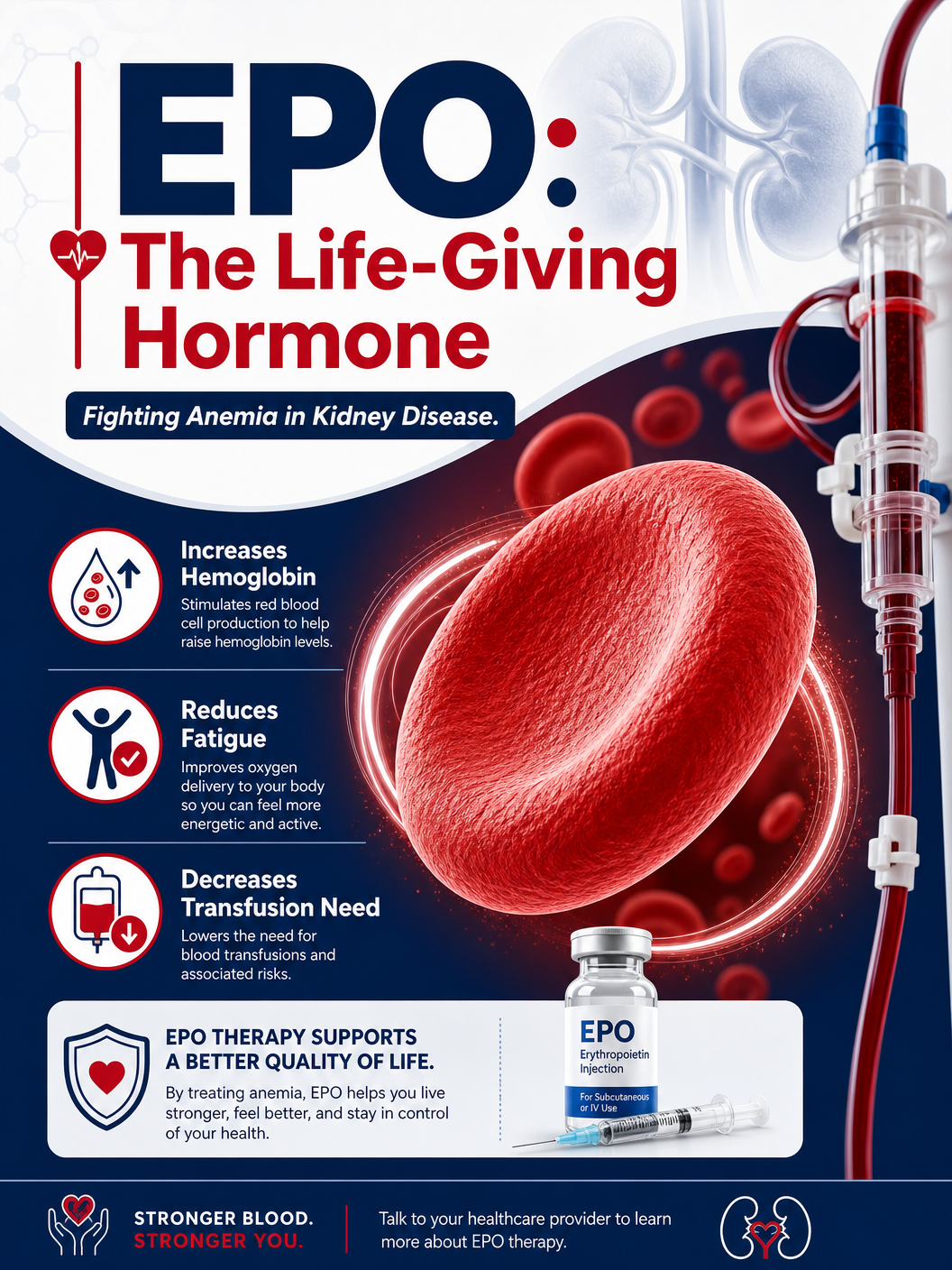
EPO — Erythropoietin
Your kidneys produce a hormone called erythropoietin, which tells your bone marrow to manufacture red blood cells. When your kidneys fail, EPO production drops dramatically. The result is anaemia — not the mild tiredness kind, but the kind that leaves you unable to walk across a room without gasping, pale, foggy, and barely functional.
EPO is that hormone, synthesised and given as an injection — either subcutaneously (under the skin) or through your dialysis line during your session.
I remember the difference EPO made when my haemoglobin was finally managed properly. I didn’t realise how exhausted I had been until I wasn’t anymore.
EPO is not without risks — it can raise blood pressure and, in rare cases, cause a condition called pure red cell aplasia. But for most dialysis patients, it is life-changing and non-negotiable.

Iron — Encifer and Other Formulations
EPO cannot work without adequate iron. Think of EPO as the instruction and iron as the raw material. Your body cannot build red blood cells without enough iron in storage — no matter how much EPO it receives.
Dialysis patients lose iron continuously — through the dialysis process itself, through regular blood draws, and through the chronic low-grade inflammation that kidney disease causes. Encifer is one brand of intravenous iron used in dialysis centres. Some patients also take oral iron supplements, though absorption is often poor in kidney disease.
Your iron status is tracked through two key markers: ferritin (your iron stores) and transferrin saturation (TSAT — how much of your iron-carrying protein is actually loaded with iron). Learn these numbers. Ask for them at your next review.
Blood Pressure Medications — Antihypertensives
Kidney disease and high blood pressure have a deeply destructive relationship. Damaged kidneys cannot regulate sodium and fluid properly, which drives blood pressure up. Sustained high blood pressure then accelerates kidney damage further. Even on dialysis, this cycle continues.
You may be on one antihypertensive or several. ACE inhibitors, ARBs, calcium channel blockers, beta-blockers, alpha-blockers — each works on a different mechanism, and your nephrologist has chosen yours based on your specific cardiovascular and kidney profile.
The most important thing: take them consistently. Including on dialysis days, unless your doctor has explicitly told you otherwise. A common and dangerous mistake is skipping them on dialysis days, assuming the machine will handle it. It won’t — not fully, and not safely.
Post-dialysis hypotension is also real. Your blood pressure can drop significantly after a session. Talk to your team about whether your doses should be timed before or after dialysis to reduce this risk.

Calcichew — Calcium Carbonate (Phosphate Binder)
This one comes with a very specific instruction: take it with food. Not before. Not after. With your meal, as you eat.
Here is why. When you eat, phosphorus from your food enters your digestive system. Calcichew — a form of calcium carbonate — binds to that phosphorus in your gut before your body can absorb it. The phosphorus then leaves your body through your stool rather than entering your bloodstream.
High phosphorus (hyperphosphataemia) is one of the most dangerous and under-discussed complications of kidney disease. It causes severe itching, bone disease, and vascular calcification — where calcium-phosphorus crystals deposit in your blood vessels and heart valves. This leads to serious cardiovascular complications and is a significant cause of death in dialysis patients.
Other binders exist — sevelamer (Renagel/Renvela), lanthanum carbonate (Fosrenol), sucroferric oxyhydroxide (Velphoro) — and your prescription depends on your calcium levels and your centre’s protocols. The principle is the same for all of them: they must be taken with meals to intercept the phosphorus before absorption.

Alfacalcidol — Active Vitamin D
Most people don’t know that your kidneys activate Vitamin D. The Vitamin D from sunlight or supplements exists in an inactive form. Your kidneys convert it into calcitriol — the active form your body can actually use to absorb calcium from your gut.
When kidneys fail, this activation stops. Without active Vitamin D, calcium absorption drops, and your parathyroid glands — sensing low calcium in the blood — go into overdrive. They produce excess parathyroid hormone (PTH), which pulls calcium out of your bones to compensate. Over time, this causes renal osteodystrophy: weak, painful, fracture-prone bones. Excess PTH also causes calcification in soft tissues, blood vessels, and organs.
Alfacalcidol is the active form of Vitamin D, replacing what your kidneys can no longer produce. It requires regular calcium monitoring, because too much can push calcium too high (hypercalcaemia). The goal is a careful balance — enough to suppress PTH and protect your bones, without tipping into excess.
Why Compliance Is Not Negotiable
Medication fatigue is real. I have felt it. There are days when the tray is the last thing you want to see, when being a patient feels like a full-time job you never applied for.
But here is what happens, concretely, when these medications are skipped:
Skip EPO: Haemoglobin falls. Transfusions become necessary. Each transfusion introduces foreign antibodies that make transplant matching harder and rejection more likely. For anyone on the transplant waiting list, this is a serious, potentially irreversible consequence.
Skip your phosphate binder: Phosphorus climbs — usually without any obvious symptoms at first. Itching begins. Calcification progresses silently. Cardiac events follow. By the time it feels serious, significant damage may already have occurred.
Skip BP medications: Blood pressure spikes. Fistulas and grafts clot. Stroke risk rises sharply. In a population already at elevated cardiovascular risk, uncontrolled hypertension is an accelerant.
Skip alfacalcidol: PTH climbs unchecked. Bone pain develops gradually, then suddenly. Fractures become more likely. In some cases, the parathyroid becomes so enlarged it requires surgical removal — a parathyroidectomy.
Skip iron: EPO becomes ineffective. Haemoglobin stays low despite the injection. Fatigue persists. The full benefit of your EPO is wasted.
Understanding the why behind each medication transforms compliance from obedience into informed self-preservation. You are not taking these tablets because you were told to. You are taking them because they are doing the work your kidneys stopped doing.
Managing the Side Effects
Epo
Can raise blood pressure — monitor yours closely, especially after starting or after a dose increase. Some patients experience mild flu-like symptoms for a day or two after injection. If your haemoglobin drops suddenly and unexpectedly despite regular EPO, flag this immediately — it can rarely indicate pure red cell aplasia.
Iron
Nausea and metallic taste are common, especially with IV iron. Dark or black stools are expected and harmless — that is unabsorbed iron. During IV iron infusions, your unit should monitor you for reactions. Oral iron is best taken with a small amount of food to reduce stomach upset.
Blood Pressure Medications
Post-dialysis hypotension is the main concern — your pressure may drop significantly after a session, making dizziness and falls more likely. Sit before you stand. Don’t skip meals. Discuss timing of your dose with your nephrologist, as some medications are better taken after dialysis rather than before.
Calcichew
Constipation is the most common complaint. Work within your fluid allowance and ask your renal dietitian about fibre sources that are also low-phosphorus. The chalky taste bothers some people — chewing quickly and following with a small permitted sip of water helps. If you are struggling with adherence because of the taste or texture, ask your pharmacist about alternative binders.
Alfacalcidol
Hypercalcaemia — too-high calcium — is the risk to watch for. Symptoms include nausea, confusion, excessive thirst, constipation, and muscle weakness. These overlap with many other conditions, which is why regular calcium blood monitoring is essential. Tell your team immediately if anything feels off.
You Are Your Own Best Advocate
Ask what every tablet is for. Ask what happens if you miss a dose. Ask about side effects and what to watch for. Request a medication review if your regimen feels overwhelming or something has changed.
You deserve to understand every single thing going into your body. Not because you are a doctor. But because you are the person living inside this body, managing this condition, and making decisions every single day.

Your medication tray is doing the work your kidneys can’t. Understand it. Work with it. And advocate loudly when something doesn’t feel right.
Leave a Reply